
Occasionally we get reports of various issues with pages, often along the lines of pages won’t update, load, or other intermittent errors. A lot of these issues relate to the fact that we are using a very aggressive caching mechanism on our sites called Nginx CGI cache to improve page load times. In any case, I thought I’d put together a list of steps I initially take to troubleshoot these types of issues.
- Can you sign into your site? If not, can you log in by tacking on ?v=1 at the end of the url to ensure caching isn’t an issue? E.g.: https://YOURSITE.colostate.edu/LOGINURL/?v=1. If not, then contact us for access.
- After logging in, you should be redirected to https://YOURSITE.colostate.edu/wp-admin/. Once there, if you see a notice that says “Elementor Data Updater – Database update process is running in the background. Taking a while?”, go ahead and click “Click here to run it now”
- Once signed into the site and browsing the page in question, have you tried clicking “Purge Current Page” in the black ribbon at the top of the page?
- Have you tried opening up a new private/incognito window and browsing/logging into your site in this way (to ensure cookies/cache are limited)?
- If you are seeing a “This page isn’t working error”, does the error go away after a page refresh (or two)?
- If you are still experiencing issues, but are able to access your Admin Dashboard (https://YOURSITE.colostate.edu/wp-admin/), can you try clicking “Purge Cache” which clears the cache for the entire site?
- Finally, if you are still experiencing issues, it’s helpful for you to send us a report of your OS/browser environment by visiting https://www.mysupportdetails.com/ and sending us the details it provides on that page.
What If 500 Errors Happen On The Same Page Repeatedly?
- We now have a tool that will automatically purge the cache of any public-facing WordPress page: https://wsprod.colostate.edu/cwis165/mojo/Monitors. You will need to request access to that system, but once you have access, you can add any url you wish. Here’s how:
- Once at the above url, click Add Monitor and enter your site’s information, just as shown in the screenshot below (obviously entering the url that’s having issues).
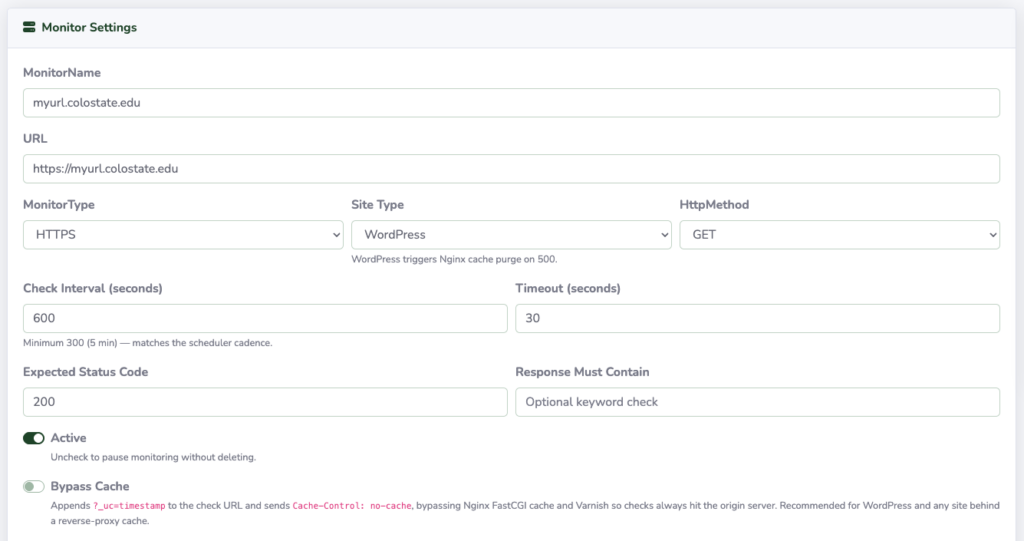
- Next click Save changes. Then, feel free to click the green “Check Now” icon on the right next to your newly-added url to have the system check the page for any issues then optionally clear the cache